Nigeria inflation rate. Headline Inflation Declines Slightly in Nigeria, But Food Prices Continue to Climb .
Nigeria inflation rate. In a slight but notable relief for Nigerians, the country’s headline inflation rate declined to 22.22% in June 2025, down from 22.97% in May, according to the latest data from the National Bureau of Statistics (NBS).
The new figures, released on Wednesday, show that on a year-on-year basis, the headline inflation rate is 11.97% lower than the 34.19% recorded in June 2024.
Month-on-month, however, inflation ticked up slightly. The rate of price increase in June was 1.68%, higher than the 1.53% observed in May 2025, indicating continued pressure on household budgets.
Despite the general drop in inflation, the food inflation rate continues to present challenges. On a year-on-year basis, food inflation stood at 21.97% in June 2025, a significant drop from 40.87% in June 2024. The NBS attributed this sharp decline primarily to a change in the base year used for comparison.
ALSO READ : NNPC Petrol Price Reduction: Fuel Drops to N865 in Lagos, N895 in Abuja
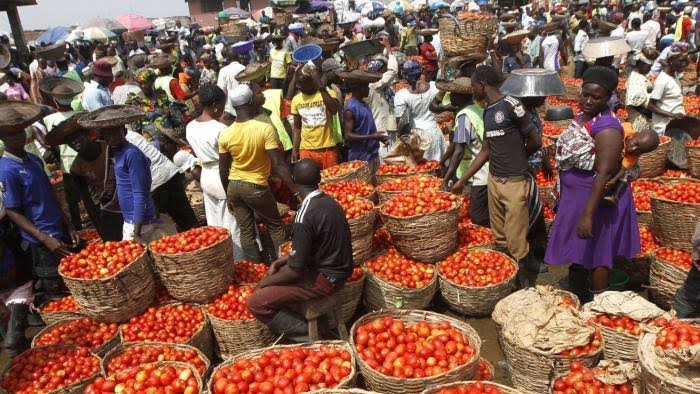
However, month-on-month, food inflation rose to 3.25%, up from 2.19% in May 2025. According to the NBS, this spike was largely driven by rising prices in essential commodities such as fresh tomatoes, dried green peas, fresh pepper, crayfish, plantain flour, and meat.
The average annual food inflation for the 12 months ending June 2025 was 28.28%, a reduction of 7.02 percentage points from the 35.3% recorded in June 2024.
Geographically, the year-on-year food inflation rate was highest in Borno (47.40%), followed by Ebonyi (30.62%) and Bayelsa (28.64%). Conversely, states like Katsina (6.21%), Adamawa (10.90%), and Sokoto (15.25%) recorded the slowest food price increases.
Nigeria inflation rate. On a month-to-month basis, the sharpest spikes in food inflation were seen in Enugu (11.90%), Kwara (9.97%), and Rivers (9.88%), while states such as Borno (-7.63%), Sokoto (-6.43%), and Bayelsa (-6.34%) saw a decline in food prices.
While the overall Nigeria inflation rate shows a positive shift, analysts caution that continued rises in food prices may still burden the average household, particularly as core staples remain volatile.