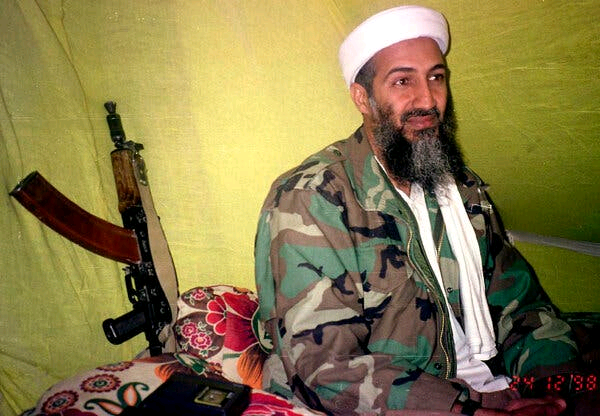
Osama bin Mohammed bin Awad bin Laden was born in 1957 in Riyadh, Saudi Arabia, into one of the richest families in the kingdom. His father, Mohammed bin Laden, was a wealthy construction magnate with close ties to the Saudi royal family. Despite his privileged background, Osama’s life took a different path — one shaped by deep religious devotion and global conflict.
Growing up, bin Laden attended elite schools in Saudi Arabia and later studied economics and business administration at King Abdulaziz University in Jeddah. During his university years, he became deeply influenced by radical Islamic scholars who preached against Western influence in Muslim countries.
The event that changed Osama bin Laden’s life forever came in 1979 — the Soviet invasion of Afghanistan. Many Muslims saw it as a call to defend their faith and land. Bin Laden left his comfortable life in Saudi Arabia and traveled to Afghanistan, where he used his wealth to support and organize Arab fighters against the Soviet forces.
He built roads, camps, and supply networks for the Mujahideen (Islamic fighters), earning a reputation as both a financier and a warrior. It was during this time that bin Laden’s influence grew, and his hatred for Western nations, especially the United States, began to deepen.
In 1988, Osama bin Laden founded al-Qaeda, which means “The Base” in Arabic. The group’s mission was to unite Muslims worldwide in a global jihad — or holy war — against those they viewed as enemies of Islam. Initially, al-Qaeda operated as a support network for Muslims fighting in Afghanistan, but after the Soviet withdrawal, it evolved into a terrorist organization targeting Western interests.Meet Graça Machel: The Only Woman Who Married Two Presidents from Two Different Countries
After the Gulf War in 1991, bin Laden grew increasingly angry with the presence of U.S. troops in Saudi Arabia, which he viewed as the desecration of Islamic holy lands. The Saudi government’s close relationship with the United States further fueled his resentment.
In the mid-1990s, bin Laden relocated to Sudan, where he built terrorist training camps and expanded al-Qaeda’s network. After international pressure forced him out of Sudan, he settled in Afghanistan under the protection of the Taliban regime.
From there, bin Laden directed a series of deadly attacks, including:
1998: Bombings of U.S. embassies in Kenya and Tanzania.
2000: Attack on the USS Cole in Yemen.
2001: The September 11 attacks in the United States, which killed nearly 3,000 people.
The 9/11 attacks brought bin Laden to global infamy and made him the world’s most wanted man.
After the 9/11 attacks, the United States launched the War on Terror, invading Afghanistan in 2001 to dismantle al-Qaeda and capture bin Laden. For nearly a decade, he evaded capture, moving between hideouts in Pakistan and Afghanistan.
On May 2, 2011, U.S. Navy SEALs raided a compound in Abbottabad, Pakistan, and killed Osama bin Laden. His death marked the end of an era, though al-Qaeda’s ideology continues to influence extremist groups around the world.
Osama bin Laden’s actions reshaped global security, politics, and perceptions of terrorism. His campaign of violence led to massive loss of life, two major wars, and a lasting sense of global insecurity.
Despite his death, the world continues to deal with the consequences of his ideology — radicalization, global terrorism, and geopolitical conflicts that began decades ago.