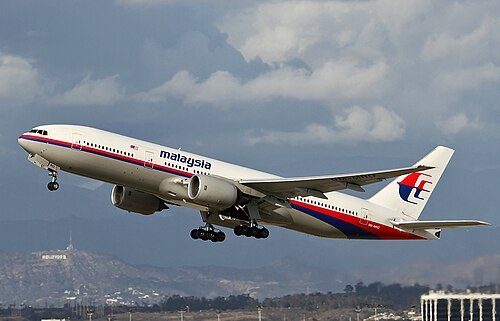
MH370’s Disappearance Still Unsolved
Malaysia Airlines Flight 370, also referred to as MH370 or MAS370, was an international commercial aircraft operated by Malaysia Airlines. On 8 March 2014, the flight went off the radar while en route from Kuala Lumpur International Airport in Malaysia to Beijing Capital International Airport in China. The reason for its disappearance has never been conclusively identified. Widely described as aviation’s greatest unsolved mystery, the incident marks the deadliest case of aircraft disappearance in modern history.
Timeline of Flight 370’s Last Contact
The missing aircraft, a Boeing 777-2H6ER registered as 9M-MRO, was last heard from approximately 38 minutes after takeoff, while flying over the South China Sea. Although it vanished from the secondary radar used by air traffic control, it was still detected for nearly an hour by the Malaysian military’s primary radar. During that time, it sharply deviated westward from its original route, crossed the Malay Peninsula, and flew over the Andaman Sea, before disappearing entirely around 200 nautical miles northwest of Penang Island.
MH370 – Aviation’s Deadliest Mystery
All 239 people onboard—227 passengers and 12 crew members—are presumed to have perished. The Flight 370 disappearance is regarded as the deadliest incident involving the Boeing 777 aircraft model, the most tragic aviation event of 2014, and the worst disaster in Malaysia Airlines’ history, until it was surpassed by Malaysia Airlines Flight 17, which was shot down over Ukraine four months later, in July 2014.

Global Search Efforts and Inmarsat Data
The worldwide search to locate MH370 became the most expensive aviation search ever conducted. Initially focused on the South China Sea and the Andaman Sea, the mission shifted after satellite data from Inmarsat revealed that the plane had likely flown far south over the Indian Ocean. The absence of official updates in the early days caused public outrage in China, especially among the relatives of passengers—most of whom were of Chinese nationality. Between 2015 and 2016, multiple fragments believed to be from Flight 370 surfaced along the shores of the western Indian Ocean, and many were officially identified as belonging to the missing aircraft.
ALSO READ : Brilliant Harvey Elliott Inspires Win
Search Suspended After Years of Effort
After combing through 120,000 km² (46,000 mi²) of ocean floor over three years, the Joint Agency Coordination Centre suspended its mission in January 2017. A second search operation led by private company Ocean Infinity began in January 2018, but it too was abandoned after six months without results.
Hypoxia and Other MH370 Theories
Relying mostly on satellite communication data with Inmarsat, the Australian Transport Safety Bureau (ATSB) put forward a theory that the aircraft may have suffered a hypoxia event—a condition caused by lack of oxygen. However, no clear consensus has been achieved among investigators. At different times, various theories were investigated, such as hijacking, crew involvement, and issues with the cargo manifest. The incident has also been the subject of widespread media speculation.
Official Report Leaves Questions Unanswered
The Malaysian Ministry of Transport’s final report, released in July 2018, did not provide a conclusive explanation for the flight’s disappearance. It pointed to the unsuccessful attempts by Malaysian air traffic control to establish contact shortly after the jet went missing. Although no cause was confirmed, Flight 370 has led to numerous aviation safety reforms. These include extending the battery life of underwater locator beacons, increasing the recording duration of flight data and cockpit voice recorders, and introducing new regulations for real-time aircraft tracking over oceanic routes. Malaysia bore 58% of the total search cost, followed by Australia at 32% and China at 10%.